


A blueprint for permanent decline: the DCMS Green Paper on BBC Charter review
By Media Reform Coalition / Friday December 19, 2025
Read More
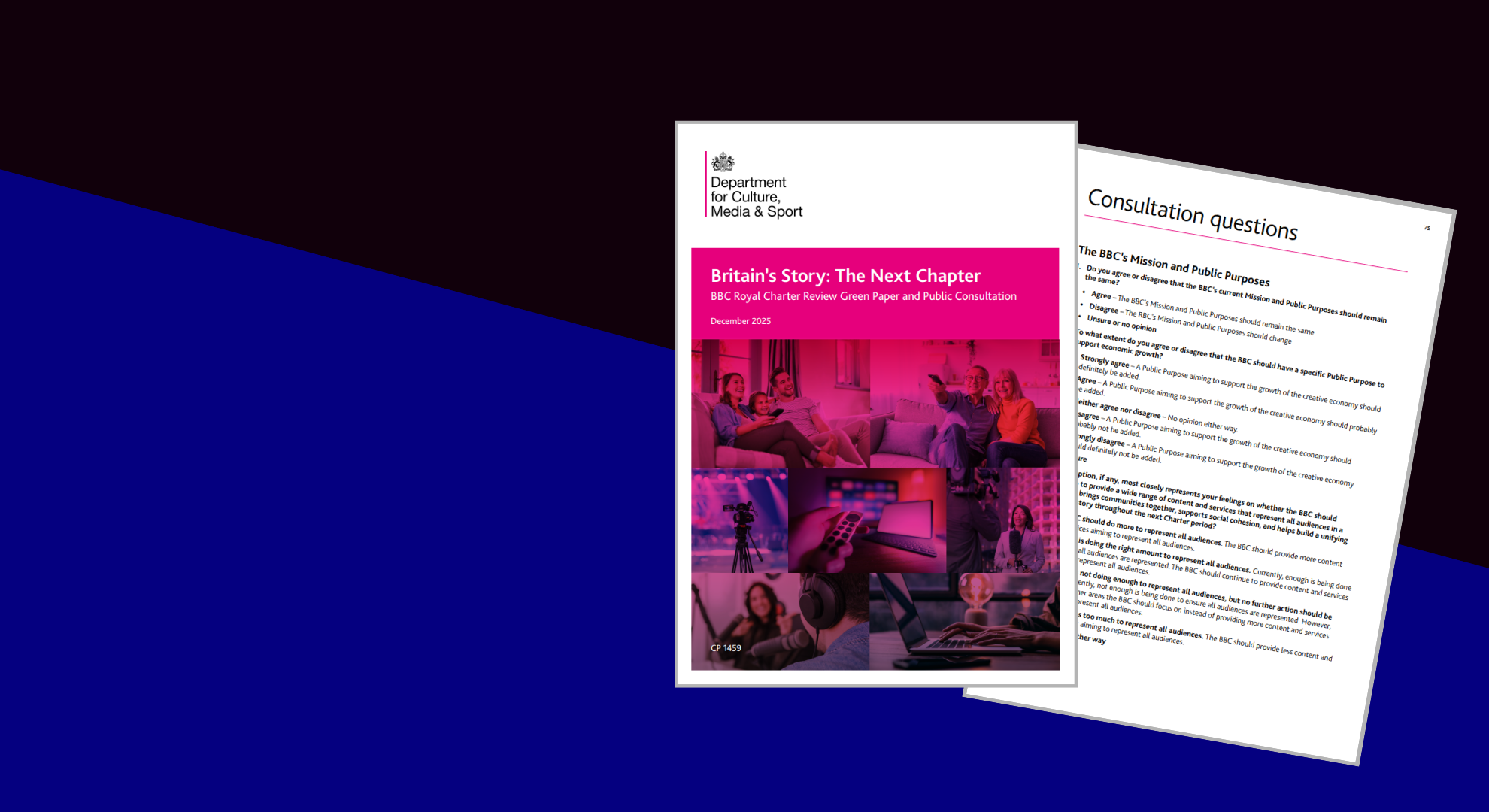
The Department for Culture, Media and Sport has officially launched the process of renewing the BBC’s Royal Charter, with the publication of a Green Paper detailing the government’s areas of focus for BBC reform – along with a public consultation inviting the public’s responses to these proposals.
The Media Reform Coalition is alarmed by many of the Green Paper’s proposals for BBC reform, especially its heavy emphasis on commercialising the BBC’s funding model, its abandonment of principles of universality, and its lack of commitment to democratic accountability.
We are also deeply concerned by the needlessly limited, confusing and rushed consultation on Charter review, which excludes the public from having a meaningful role in deciding the BBC’s future.
We urge the Government to immediately extend its proposed timetable for Charter renewal and establish a national series of Citizens’ Assemblies, so that the views and interests of BBC audiences – and the wider British public – are at the centre of shaping the BBC’s next Royal Charter.
This blog post outlines the MRC’s initial analysis of the Government’s Green Paper and consultation. Along with future MRC submissions and research, we plan to organise public events with civil society partners, policymakers, unions, media organisations and others.
We want to ensure this once-in-a-generation debate on the BBC’s future involves as wide a range of voices as possible, and is not restricted to just a narrow group of industry interests and private negotiations between Ministers, the BBC and dominant commercial players.
If you would like to collaborate with the MRC as part of our campaigning on BBC Charter review, please get in touch. Further updates on the MRC’s work will be listed on our BBC Charter review campaign page.
The public consultation: a disappointing tick-box exercise
- IN BRIEF:
- A rushed 12-week online survey with confusing and poorly designed questions that undermine the public’s right to engage in and influence Charter renewal
- Limited options to challenge or dispute the Government’s analysis & proposed areas of reform
- No obvious intentions to expand or even continue public participation in deciding the BBC’s future after this tick-box exercise
The BBC Charter review is the most important decision about the UK’s media in over a decade. It follows that the British public – who fund the BBC, use its services and whose lives are shaped (for better or worse) by what the BBC creates – deserve a direct role in debating and deciding what kind of BBC we want, how it is organised and what its purposes should be. The Government’s public consultation on BBC Charter renewal, however, is little more than an online survey. It squashes the public’s role in shaping the future of the BBC into 32 tick-box questions, many of which are poorly designed, expecting expert knowledge to understand and are therefore unlikely to produce useful findings on the public’s views.
Some of the questions trivialise vital debates on BBC reform. Question 1 asks simplistically if respondents “agree or disagree that the BBC’s current Mission and Public Purpose should remain the same?” – with no opportunity for respondents to evaluate the Mission and each Purpose individually, offer thoughts on how well the Public Purposes function, or to specify what they would like to keep or change.
Other questions present answers in leading language that negates the public’s opportunity to reject or challenge the Government’s apparent preferences for reform. Question 27 asks if the TV licence fee “should be reformed to support the BBC’s long term sustainability“, with none of the answers (or any of the other questions) allowing respondents to separate the urgent question of reforming the licence fee from the broader topic of the BBC’s financial sustainability.
Along with over-simplified “agree or disagree” framing, the consultation also features ‘shopping list’ questions. These present numerous non-exclusive and positive-sounding options for BBC reform, which would be difficult for anyone to disagree with. There is no further explanation of how these reforms would work – information that might help deliver richer and more informative responses. For example, the proposals in Question 8, on “options aiming to enhance the BBC’s accountability”, are unlikely to draw furious public opposition. Yet there are certainly widely contrasting public views on (and limited public understanding of) what it means in practice to e.g. change the structure of the Board, enhance parliamentary scrutiny of the BBC, or to require the BBC to “hear regional perspectives”. The questionnaire allows just a 200 word free-text box for more detailed contributions – suggesting that Government is not interested in further public discussion on these major matters of governance, independence and accountability
The Government’s choice to launch a 12-week consultation in the middle of December – days before many will take time off for the Christmas holidays – shows a lack of concern for the importance and value of public participation in policymaking, which undermines the democratic quality of any potential outcomes. The Government’s terms of reference suggests that this rushed and confusing survey will be the only opportunity for the general public to contribute to Charter review, before Ministers proceed with opaque ‘stakeholder engagement’ and behind-closed-doors negotiations that typify so much media policymaking.
As it stands, the consultation does not lessen the current risks to the essential democratic legitimacy of the BBC, with the views and desires of the BBC’s most vital stakeholders – the British public and licence fee payers – reduced to a handful of percentage figures from a survey that is highly unlikely to deliver meaningful impact.
Licence fee ‘reform’: abandoning universal public service
- IN BRIEF:
- The Government has ruled out any alternative public funding model, despite overwhelming evidence of the failures and unsustainability of the TV licence fee
- The Green Paper does not mention reforming Government control over setting the licence fee, which has been a cause of decades of political pressure and anti-democratic political control over the BBC’s finances
- Options presented for making the licence fee fairer will weaken the BBC’s obligations as a universal public service
The BBC faces extreme financial pressures that constrain its ability to provide a universal public service. These have been driven primarily by successive government freezes and below-inflation increases in the value of the licence fee, which have created a 40% real-terms cut to the BBC’s public income since 2010 – resulting in devastating reductions and closures of core BBC services.
Yet in its Green Paper the Government claims “the BBC receives a level of public funding commensurate with its role” (pg. 63), which will come as a surprise to audiences who have seen the BBC cut 1,000 hours of programming, cut hundreds of jobs from its news services & trashed its hugely popular local radio network.
The licence fee as a funding model is deeply unpopular, outdated and unfair to the poorest households, and it allows the government to attack and pressure the BBC through unilateral control of its public funding – as former Chancellor and axeman-in-chief George Osborne coyly admitted to The Times (£):
“the Chancellor can basically boss the BBC around on its finances because the government sets the licence fee.”
Despite the clear case for radical reform to restore the BBC’s public funding, the Green Paper presents a strangely complacent view of the future of the licence fee. The Green Paper (pg. 71) describes the licence fee as a “tried and tested” model, without elaboration or justification, and categorically rules out replacing it with any other forms of public funding – such as general taxation, a levy on streaming services or a universal household charge as supported by the MRC, the Voice of the Listener and Viewer and the Citizens’ Forum for Public Service Media. The Green Paper does not raise the question of ending the Government’s unaccountable and unjustifiable control over setting the licence fee, despite frequent mentions of a desire to “strengthen and uphold the BBC’s independence”.
Where the government proposes changes to how the licence fee is collected, or new concessions and discounts that might support poorer households in contributing, these are framed entirely as opportunities to continue reducing the BBC’s overall level of funding. The Green Paper suggests that the Government’s overarching policy on BBC funding is heavily focussed on increasing commercial sources of revenue; it includes only glancing thoughts of how this would unavoidably limit the BBC’s capacity to provide a universal public service to meet the needs and interests of all audiences.
Public funding for the BBC requires radical reform, especially reforms that create a more direct and democratic link between the public’s ownership of the BBC and the services it produces. However, at its core the Green Paper represents a misguided approach to this central question, and a dangerous abdication of the Government’s responsibility to establish a model for the BBC’s public funding that would form the basis of a universal, democratic and genuinely independent national public service.
Commercial reforms: a point of no return
- IN BRIEF:
- A very limited focus on increasing the BBC’s commercial revenues threatens to further detach the purposes of the BBC from British audiences who fund and own BBC services
- Plans to introduce advertising, subscription or pay-walls run counter to established evidence & industry concerns, ignore audiences’ expectations and will not secure sustainable BBC funding
- Additional proposals, like selling the BBC Archive to AI companies (pg. 68), expose the Government’s lack of interest in the cultural and social value of BBC content and the right of the British public to retain ownership of historical national treasure
Throughout the Green Paper, increasing the BBC’s commercial revenue is presented as a natural solution to financing the BBC in the challenging modern media economy, scarcely deserving of discussion. It is, however, an ideological belief rather than an inevitability.
It is true, as the Green Paper details, that the share of total BBC income derived from commercial sources has risen markedly, from 22% in 2015/16 to 35% in 2024/25.
But this is not because of any uniquely commercial success story of BBC Studios, the production and distribution arm created by the last Royal Charter settlement in 2017. Rather, it is a consequence of 15 years of stagnated public income following government attacks on the licence fee, which have forced the BBC to depend on commercial revenues while still cutting back its public services.
The false notion that increased commercial revenues would be “reinvested” in public services, to make up the public funding shortfall, does not stand up to reality. The current annual ‘dividend’ of just £120m going from BBC Studios to the BBC’s core public services doesn’t even touch the sides in reversing the annual loss in public income from licence fee freezes.
The Green Paper’s proposals for “growing BBC Studios” (pgs. 67-8), and thus making the BBC even more dependent on commercial income, suggests the Government either doesn’t understand – or isn’t concerned by – how commercial models are entirely at odds with the BBC’s mission as a universal public broadcaster. Commercial revenues require serving the largest or most profitable audiences, or selling the BBC’s production services and content rights (IP) to private companies. The basic notion that content commissioned for the BBC, and paid for by licence fee payers, belongs to the public is absent from the Green Paper.
This belief in an inevitably more commercial BBC is also shown in the Green Paper’s insistence that allowing advertising on the BBC – which has never featured adverts on any of its public services for over a century – is a golden opportunity for securing its future funding. Here, the Paper’s own evidence completely undermines its case. It claims that limited or even full advertising on BBC services could “potentially generate significant revenue”, while simultaneously noting that commercial broadcasters’ revenues from TV advertising are in terminal decline. Non-linear advertising through digital platforms is also highly unlikely to supplement, let alone replace, the BBC’s public income as a foundation of BBC funding, given how this market is dominated by the online search and display monopolies run by Meta and Google.
Proposals to create a two-tiered BBC, through the introduction of pay-walls or subscription for “more commercially viable TV content” (pg. 70), are grounded in a decades-old ideological assault on the principles of public media; to inform, educate and entertain all audiences. These are debates that were rehashed and exhausted 10 years ago, when the Conservative government (that had otherwise been openly hostile towards the BBC) reluctantly conceded that providing free-to-air popular programming was an essential part of the BBC’s mission to be universal.
This time around, the Green Paper manages little more than a nod at the many practical problems and deeper questions of principle that come with abandoning a universal free-to-air service. For example, the Paper casually suggests that some programmes or services might be locked behind a pay-wall “if the BBC chose to do so“, placing the blame for audiences losing access to their favourite programmes squarely on the BBC itself. Then it notes that the introduction of pay-walls or subscription would bring “a reduction in the level of the licence fee to reflect the BBC’s narrower TV remit” – creating a sinister double-bind where the BBC has less public money to make content, forcing it to commercialise a larger share of valued free-to-air content, in turn reducing the BBC’s overall public service and motivating even further reductions in the licence fee.
None of these scenarios would “support the BBC to thrive and deliver against its public service obligations”, as the Green Paper claims is the Government’s ambition. Rather they would shatter the foundational compact between the BBC and the public that funds it, creating a point-of-no-return for guaranteed public investment in universal services, and force the BBC to further reduce the range and diversity of services it can provide free-to-air for the whole UK.
Democracy and accountability: where is the ambition for reform?
- IN BRIEF
- The urgent need for introducing genuinely democratic accountability into the BBC’s governance is bypassed
- The British public are not seen as capable of an active and direct role in how the BBC is run – as the Culture Secretary has previously endorsed
- No commitment to ending antidemocratic government control over appointments to the BBC Board – and an implication that the Government wishes to keep dangerous political influence by retaining power to appoint the BBC Chair
- Enhancing BBC transparency, changing its external accountability and tinkering with the length of the Royal Charter will achieve nothing if they are not part of a more fundamental overhaul of the BBC’s relationship with its most important stakeholders – the British public
In 2020 Lisa Nandy argued for mutualisation of the BBC, saying that it had a duty to “be accountable to those who fund it”:
“Instead of tokenistic consultation with the people who pay for it, and backroom negotiations with the government, the BBC should move to a model of being owned and directed by licence fee holders – who can help decide the trade-offs that the BBC must make to secure its future.”
Put aside the irony that Nandy herself has created another “tokenistic consultation”. The principles she expressed are pivotal to the BBC’s future – as a national public institution, the BBC depends on the trust of its audiences. Recent scandals and long-running systemic failures in how the BBC is governed – not least the Government’s direct control over appointments, the licence fee, and its constitution via the Royal Charter – have only enhanced the case for a truly radical transformation of how the BBC is run and held to account, as outlined by Nandy in 2020.
Bafflingly, none of these principles is present in the Green Paper. Its proposals on accountability and independence pay plenty of lip service to “the social contract between the BBC and licence fee payers”, but show no awareness of the essential democratic basis of this contract, which has been absent since the BBC’s foundation. The Government’s proposals default to worn-out distractions around enhancing transparency, new mechanisms to ensure “that everyone feels their voice has been heard“, or tinkering around the edges of the BBC’s current governance model – such as expanding Ofcom’s regulation of the BBC, or introducing a more formal role for parliament in holding the BBC to account.
These ideas have their merits, but would not deliver enhanced public trust, accountability or engagement with the BBC as a civic and democratic institution. It is particularly strange, given that the Government appears to understand current frustrations with the BBC’s lack of accountability, for example in its comments on how the BBC needs to address “declining engagement with, and trust in, the BBC” (pg. 22):
“Often the work undertaken is not widely promoted or understood, including low awareness from the public on how they can get involved and contribute their views. Engagement needs to happen in a way that is visible to audiences, ensuring that everyone feels that their voice has been heard.”
Again, ignore the irony that the Government has not applied this bold support for meaningful public engagement to its own Charter review process. Unless the public can meaningfully engage with and influence the BBC through mechanisms of democratic accountability that have longevity, accountability and genuine power, then the social contract the BBC holds with its audiences will not survive. The Green Paper’s unimaginative suggestions for bureaucratic reforms or requirements for more ‘listening exercises’ are a long way away from addressing what the Government clearly recognises as an existential threat to the BBC’s future.
The recent crisis around the leaked BBC Board memo, and the on-going allegations of entrenched political interference by serving BBC Board members, has helped bring greater public awareness to the antidemocratic and unjustifiable role of political appointees on the BBC Board. Only a few weeks ago, ending the government’s power to directly appoint the Chair of the BBC and non-executive members of the BBC Board seemed like the largest political open goal in the history of BBC reforms. Yet the Green Paper is at pains to avoid acknowledging the obvious political interference that stems from Board appointments. It offers only, in non-committal tones, to consider “whether there should be a change to the government’s role in appointing Board members”.
The consultation questions give further clues about the Government’s reluctance to surrender its power: Survey Question 8 on “enhancing the BBC’s accountability” provides an option “reducing the government’s role in board appointments to appointing the Chair only.” Like many of the consultation questions, this leading framing attempts to shut down any discussion of reforms that might go beyond what powerful political figures find acceptable. Even if the public wanted to see an end to political appointments entirely, it seems the Government has already decided for us that this simply isn’t within the scope of Charter review.
New Public Purposes: some good, some pointless, some ignored
- IN BRIEF:
- The Government has not provided sufficient evidence or a coherent rationale for creating new or updated Public Purposes that distinctly requite accuracy and the BBC contributing to economic growth.
- The Public Purposes on public-purpose innovation and providing UK audiences with international content, abolished in the last Charter review, should be re-introduced.
- The next Charter should include new Public Purposes that require the BBC to
- (a) promote media literacy, especially by empowering the public as active, informed and engaged citizens in the modern media landscape
- (b) act as an ‘anchor institution’ for restoring and expanding the UK’s local media, especially by collaborating with independent local news providers and making its local resources available for community use & participation.
The BBC’s Royal Charter details the Public Purposes of the BBC – the top-level requirements for the kinds of content, services and public benefits the BBC should provide. They serve as a foundational definition for what the BBC does and why it exists, as well as a regulatory benchmark for evaluating the BBC’s activities.
To some extent, the Green Paper explores debates on introducing new Public Purposes in the renewed 2028 Royal Charter. However, there is little evidence of a coherent philosophy behind the discussion, nor a consideration of how concise and clear the BBC’s mission may (not) be if all the Government’s new Purposes were adopted.
Accuracy – The section on ‘Trusted, impartial and accurate BBC news’ (pg. 35) includes a proposal to “give accuracy equal importance alongside impartiality” by updating the BBC’s Public Purposes. The word ‘accuracy’, however, features just 5 times in the entire 92-page document, so it is not at all clear what has motivated the Government to see this as a vital and urgent addition to the BBC’s headline objectives. The BBC already features requirements for accuracy as part of its editorial guidelines, which are not only the binding standards code for the BBC’s news content but are also subject to external regulation and complaints oversight by Ofcom. The Government will need to justify what is currently lacking in the BBC’s Mission and editorial principles that merits such a revision to the BBC’s Public Purposes.
Technology – The previous BBC Royal Charter (2006-2017), which first introduced the Public Purposes, included a requirement to “deliver to the public the benefit of emerging communications technologies and services”. The current Charter (2017-2028) relegated this objective to a separate clause, meaning that the BBC had no foundational priority for being a leading player in ‘delivering tech for public good’ during the most significant period of expansion, development and market consolidation in the areas of digital platforms, Big Tech and data.
The Green Paper’s section on BBC R&D suggests that the next Charter might put “research, development and innovation firmly back at the centre of the BBC’s public service activities, potentially as part of a new Public Purpose on driving growth” (pg. 55). Restoring the abandoned public purpose certainly has appeal, but the Green Paper’s discussions for this are limited to only the benefits of public innovation in an industrial sense, such as “shar[ing] best practice and support[ing] the wider sector in benefiting from any advances”. This is quite different from the motivation of “delivering to the public” that was foremost in the previous Public Purpose on tech. Nowhere in the Green Paper has the Government considered any scope for the BBC to be an innovative player in developing public social media, video-sharing or digital communications platforms, seemingly content to leave these spaces dominated by unaccountable, exploitative profit-maximalising Big Tech companies with no commitments to the public interest.
Growth – A glancing look at the BBC’s role in tech is nested within what the Government clearly feels is its winning addition to the BBC’s next Royal Charter – “a new BBC Public Purpose focused on driving economic growth” (pg. 52). The consultation survey features this upfront as Question 2, with DCMS (or more likely, the Labour government) perhaps hoping to record a high number of positive responses before the public get tired with the rest of the survey. The Green Paper devotes significant space (and unusual detail) to celebrating the BBC’s contributions to the UK’s creative industries, through econometric medals like Gross Value Added, £s created per £s spent, investment in the nations and regions, and so on.
Little of this analysis is under dispute – the BBC is a major (if not the most significant) economic contributor to the UK’s broadcasting, arts, culture and creative sectors. Yet adding this role as a Public Purpose risks encouraging the BBC to engage in activities that are geared towards serving consumers and businesses, rather than keeping to its foundational mission as a public service media institution serving audiences and citizens. As the Green Paper’s own analysis demonstrates, the BBC’s public investment already creates significant economic growth, industrial infrastructure and talent development for independent producers, media workers and businesses across the UK. This is the outcome of public investment, and the Government ought to focus more on how to sustain the funding needed to deliver what audiences expect from the BBC, rather than creating redundant new requirements that are in fact already being delivered.
There are also several key areas where the BBC should, in the MRC’s view have more formalised and updated Public Purposes. Some are mentioned in the Green Paper, while others are overlooked entirely:
Local media – the UK’s local media faces an existential crisis, driven by corporate consolidation, concentrated ownership and mass closures of local newspapers, radio stations and community media outlets. The Green Paper recognises this, but repeats the dominant narrative of the commercial sector that the BBC is ‘treading on the toes of the market’. It proposes expanding the Local Democracy Reporter Scheme – which in practice is a public subsidy for the largest regional news publishers, who chose to withdraw from local news provision for commercial reasons – and requiring the BBC to “explore partnerships with high quality local media outlets” (pg. 41). “The aim of this,” it continues, “would be to improve BBC access to local knowledge and insight, while providing other outlets with access to technology, skills and networks”.
This all sounds good in principle, but it is vulnerable to capture by dominant commercial players who have already demonstrated a lack of commitment to sustaining local public interest news provision across the UK’s towns and communities. Any new requirements about the BBC’s role in local media, including a Public Purpose, need to have the needs and interests of local communities at their heart – and not merely focus on protecting existing commercial players or addressing ‘market gaps’. A Public Purpose that establishes the BBC as an ‘anchor institution’ – grounded in communities as an independent, accountable and publicly-owned media organisation, that also partners with local civic institutions to make its resources available to the public – will not only reinvigorate local media, but also significantly enhance the public’s relationship with and power over the BBC.
International content – The 2017-2028 Royal Charter removed reference in the Public Purposes to “bringing the UK to the world and the world to the UK“, implying that British audiences had nothing to benefit from having access to a wide range and diversity of content made outside, and sharing experiences from, outside the UK. This permitted the BBC to reduce investment in commissioning and acquiring content from around the world. The next BBC Royal Charter should reintroduce a Public Purpose commitment to ensuring high-quality international content covering global affairs is made widely available and accessible to UK audiences.
Media literacy and public empowerment – Most policy and industry conversations on media literacy appear concerned only with the harms and threats from mis- and dis-information, primarily “aiming to help individuals understand, evaluate and think critically about information” (pg. 33). This is an essential aim in our current information crisis, and something that the BBC should pay a leading role in seeking to tackle. However, this educational model of media literacy does not recognise the potential for public empowerment by promoting citizens’ ability and right to social, cultural and civic self-expression through media institutions. Too often ‘the media’ is treated as something that is ‘done to’ the public, rather than a process in which we all share and should play an equal and common part. A new Public Purpose on media literacy, enhancing the BBC’s role as an open and participatory institution, would be hugely valuable.
A hollow vision for the BBC in 2040
Many of the BBC’s most significant failures over the last decade stem from the misguided and ideological reforms put in place by the 2017-2028 Royal Charter. Its commercialised philosophy and politicised governance reforms, coupled with hugely damaging cuts to the licence fee, has left the BBC adrift at the moment of maximum vulnerability for its future – with inescapable consequences for the British public.
Despite this, the DCMS 2025 Green Paper expresses a hollow vision for the BBC and public media for the next BBC Royal Charter, which will see the BBC up to the 2040s and beyond. If some of the narratives we have critiqued are formally adopted in the renewed Charter, it will be a blueprint for permanent, perhaps irreversible decline. The BBC’s vital public services will become increasingly marginalised and commercial models will dominate more and more of what the BBC does, while the public remain passive audiences with no power to shape or influence how the BBC serves them.
This is a counterproductive and contradictory plan for the BBC. It asks for an effective public service without any of its essential foundations; a universal service that caters to the needs and interests of all nations and communities of the UK, while simultaneously providing popular content that brings the nation together.
This contradiction is captured in the Green Paper’s discussion on ‘delivering services for the public good’ (pg. 38). It talks about the BBC’s obligation to “act differently to other broadcasters”, and need to “make tough decisions” about what content to commission. Then, just a few sentences later, it says Charter review needs to address “how the BBC is able to provide a broad and deep range of content”.
These are not two awkward sides of the same unfortunate coin. They are completely opposite political choices about why the BBC exists and how it should serve its audiences. It is impossible to have a universal BBC that also restricts itself to market gaps and cuts away at services for expendable or commercially unviable audiences.
Without a coherent philosophy in support of public media, or any authentic and consequential mechanism for allowing the public to make this case themselves, it is difficult to see how a renewed Royal Charter will ensure the BBC survives the next decade, let alone sets it “on a path to thrive well until the latter half of this century” as the Culture Secretary wishes.