

Public Media Ireland: a radical vision of PSM in a United Ireland
By Phil Ramsey and Roderick Flynn / Friday January 23, 2026
Read More
Trying to design a Public Service Media (PSM) organisation for a country that does not (yet) exist might seem a bit premature.
However, the question of what would happen to the existing PSM organisations in the Republic of Ireland and Northern Ireland – RTÉ and the BBC, respectively – if Irish reunification was to occur, requires urgent attention. There have been extensive and necessary debates about what the economy, health service and education system of United Ireland might look like. However, working through the possible institutional arrangements for PSM should take precedence because PSM constitutes much of the space where public discussion influencing the shape of structures appropriate for a new Ireland will occur.
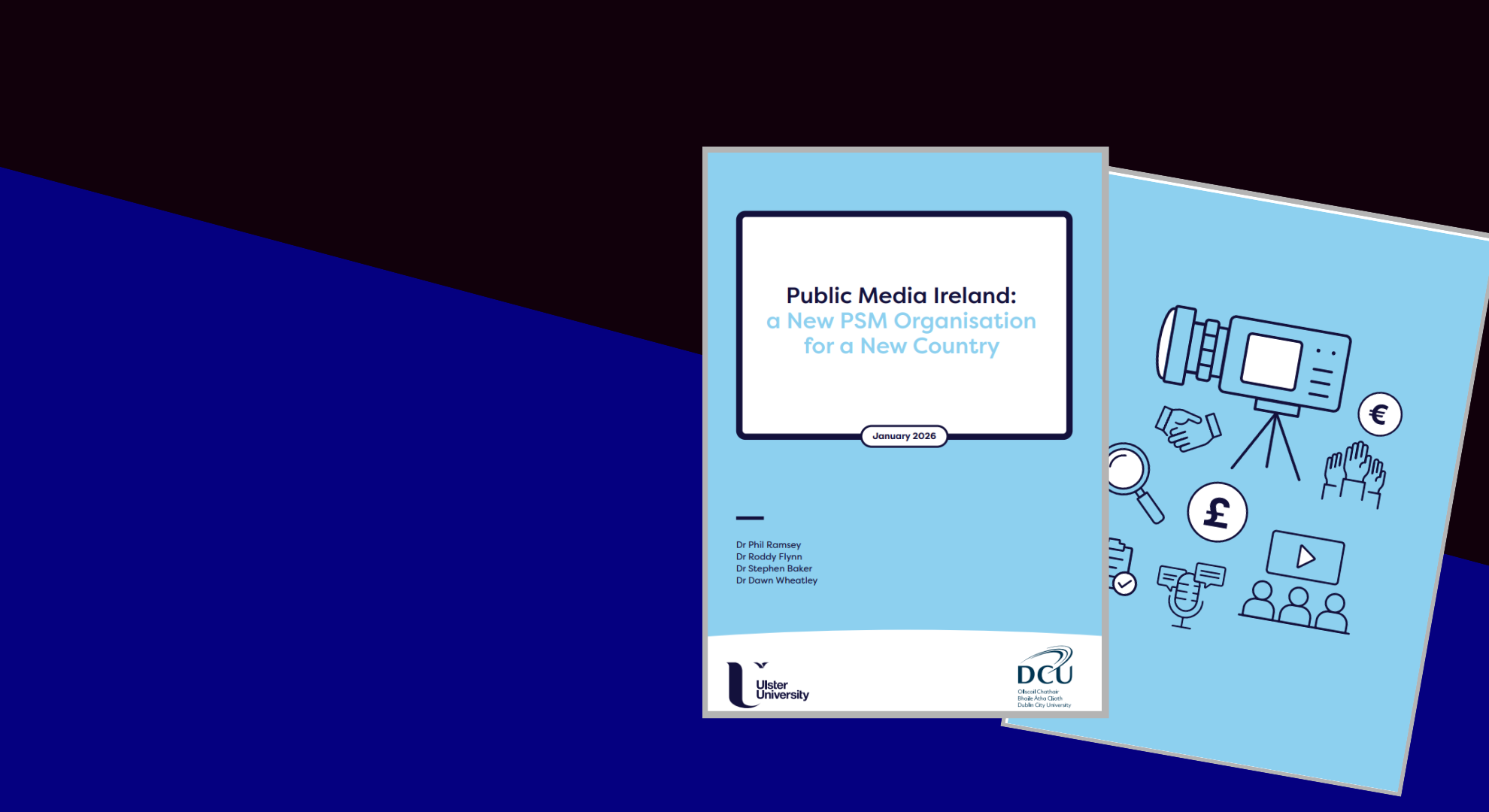
In a new report, Public Media Ireland: a New PSM Organisation for a New Country, we – Phil Ramsey and Steve Baker from Ulster University, and Roddy Flynn and Dawn Wheatley from Dublin City University – have attempted to set out the options.
Irish reunification is not a foregone conclusion. Opinion polls continue to show that most people in Northern Ireland would support remaining in the UK, and there is no immediate prospect that that will change. But political change is in the air, with Michelle O’Neill of Sinn Féin becoming Northern Ireland’s First Minister in 2024, the first Irish Republican to hold the office. Moreover, there has been an intensification of debate around how a reunified Ireland would work in practice. In For and against a united Ireland, journalists Fintan O’Toole and Sam McBride have highlighted pertinent and sometimes surprising aspects of the debate: so while concern might be expressed about the fate of the cherished NHS in a united Ireland, O’Toole and McBride note that life expectancy in the Republic of Ireland is now more than two years longer than in Northern Ireland.
In our report, we set out five possible options for what might happen to PSM should reunification take place:
- Status Quo: RTÉ carries on, while BBC Northern Ireland retains a presence even if it is unclear as to how the BBC would be funded in the absence of the payment of UK TV licences;
- Subsumption: RTÉ subsumes BBC Northern Ireland into its operations, an option we argue is neither particularly viable nor welcome;
- New Provision: our preferred option – which sees a new PSM organisation established;
- Full Marketisation: whereby the formation of a new country is seized on by market fundamentalists to abolish PSM altogether;
- Some combination of the first three options.
In arriving at ‘New Provision’, Public Media Ireland is partially inspired by the 2014 Scottish Independence White Paper proposal to create a new Scottish Broadcasting Service (SBS), which would have “initially [been] founded on the staff and assets of BBC Scotland”.
We ask in the report: given a tabula rasa, what kind of PSM organisation would you create for a new Ireland? Such an occasion would offer an opportunity for a bold redesign of public broadcasting; a radical chance to do something new, which takes account of the many social and political challenges which persist in Ireland, North and South. We use the report to make thirteen recommendations, introducing as much nuance as possible.
We work our way through subjects that include the role and purpose of PSM, how journalism might function, and whether a shared journalistic culture across the island might be sustained. We consider language provision, and how it should reflect a changing Ireland in terms of demography; and look at how a new PSM would be funded, suggesting Finland’s model for the funding of YLE as worthy of serious consideration. And we discuss Governance, drawing from the extensive work of the Media Reform Coalition, to propose models which reverse the concentration of PSM appointments in the hands of central government. In that regard we also consider enhancing the role of Trades Unions and workplace democracy.
At this early stage, no report like this can exhaustively address every question a PSM organisation for a unified country throws up. And even if it did, it would only scratch the surface of the wider cultural questions which would need answered. These include two greatly different approaches to DAB radio, and the fact there are currently two media regulators – and two Arts Councils – contained within one medium-sized island. Extensive financial and legal negotiations would be needed to establish a new PSM organisation, and as we say in the report, that is before you get to asking the audience what kind of media provision they might want.
However, we suggest, national democracies are not a given just waiting to be discovered: they are made – and the media can play an important role in that. Public Media Ireland might just be such a starting point.