



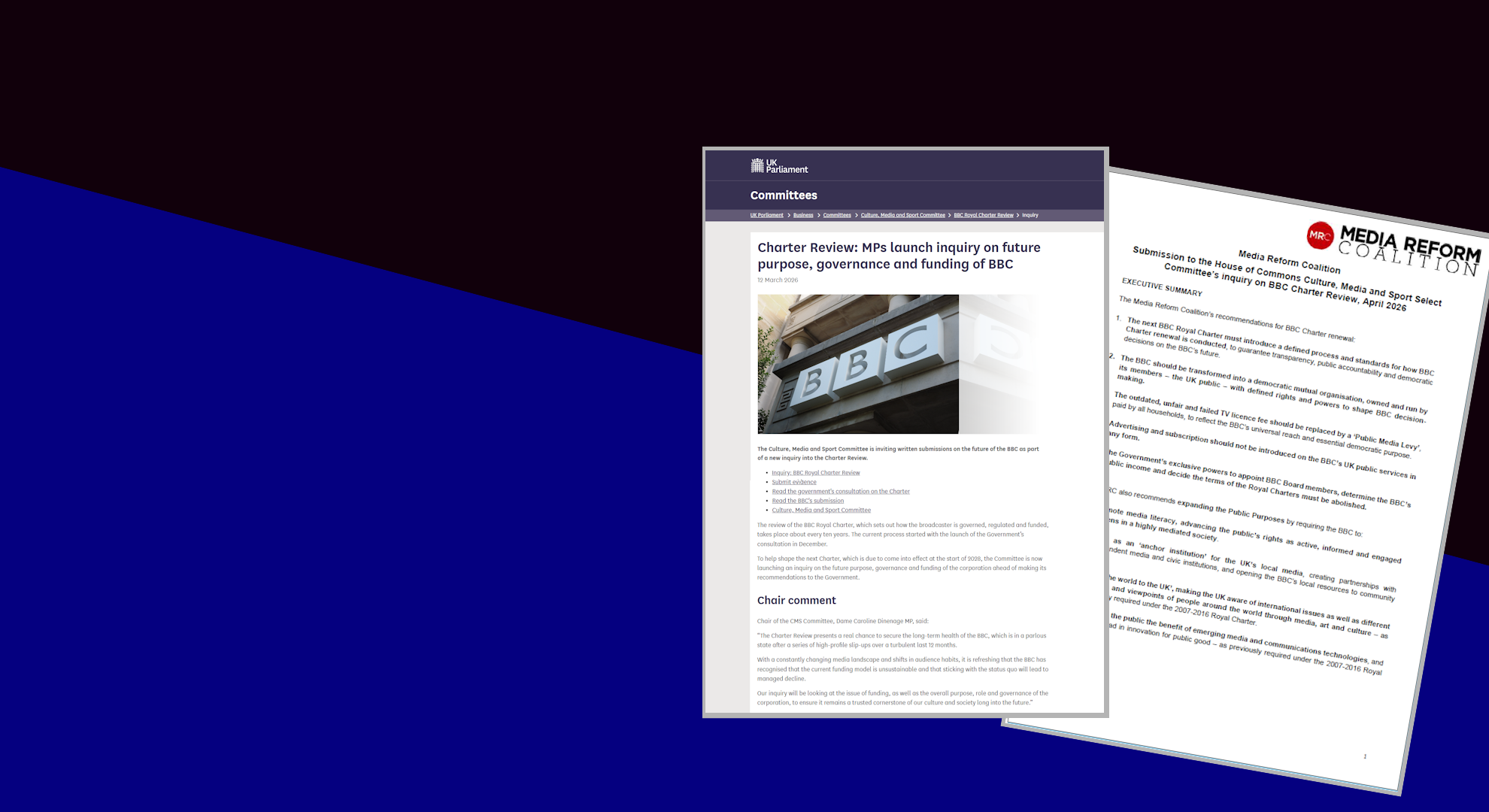
The MRC’s submission to the Culture, Media and Sport Select Committee’s BBC Charter Review inquiry
By Media Reform Coalition / Tuesday April 21, 2026
Read More
READ: The MRC’s submission to the CMS Committee on BBC Charter Review
The House of Commons Culture, Media and Sport Select Committee is hosting an inquiry on BBC Charter Review. These sessions allow MPs to subject the government’s proposals for BBC reform to parliamentary scrutiny, and also allow for industry stakeholders, campaign groups and wider civil society to present their own evidence and recommendations on the future of the BBC.
Crucially, these inquiries are an opportunity to create a genuinely open, wide-ranging and evidence-led public debate on the BBC.
Since the Government officially launched BBC Charter Review in December last year, the process has been appallingly opaque, lacking in meaningful public accountability and deeply undemocratic. The DCMS public consultation was a limited, rushed tickbox exercise, while Ministers have made sweeping announcements about BBC reform that have not been open to any scrutiny, debate or public consent.
In our submission to the inquiry, the MRC has called on the Committee to ensure that Charter Review is informed by the widest possible range and diversity of views, interests and evidence – especially from voices beyond established media industry stakeholders and professional political influencers who typically dominate media policy debates.
We also set out a programme for radical reforms of the BBC, grounded in clear evidence and essential principles of independent, accountable and democratic public media:
- The next BBC Royal Charter must introduce a defined process and standards for how BBC Charter renewal is conducted, to guarantee transparency, public accountability and democratic decisions on the BBC’s future.
- The BBC should be transformed into a democratic mutual organisation, owned and run by its members – the UK public – with defined rights and powers to shape BBC decision-making.
- The outdated, unfair and failed TV licence fee should be replaced by a ‘Public Media Levy’, paid by all households, to reflect the BBC’s universal reach and essential democratic purpose.
- Advertising and subscription should not be introduced on the BBC’s UK public services in any form.
- The Government’s exclusive powers to appoint BBC Board members, determine the BBC’s public income and decide the terms of the Royal Charters must be abolished.
The MRC also recommends expanding the BBC’s Public Purposes – the Corporation’s top-level objectives set out in the Royal Charter – by requiring the BBC to:
- Promote media literacy, advancing the public’s rights as active, informed and engaged citizens in a highly mediated society.
- Serve as an ‘anchor institution’ for the UK’s local media, creating partnerships with independent media and civic institutions, and opening the BBC’s local resources to community use.
- ‘Bring the world to the UK’, making the UK aware of international issues as well as different cultures and viewpoints of people around the world through media, art and culture – as previously required under the 2007-2016 Royal Charter.
- Deliver to the public the benefit of emerging media and communications technologies, and taking a lead in innovation for public good – as previously required under the 2007-2016 Royal Charter.